Ignored 26: Summer good/bad

ignored26

The concept of “summer” has a bit of a personality crisis in the world of popular music.

Some songs about summer contain lyrics about having fun, basking in sunlight, the kind of activities that Jimmy Buffett is into, etc.

Some songs about summer contain lyrics about #heavy topics such as growing old, lost love, dying, getting ready to die, etc.

Naturally, it’s about time that somebody created a(n) (info)graphic that maps summer songs on a continuum with “partying” being the ceiling of the positive and “death” being the floor of the negative.

Criteria for inclusion
1. Must have the word “summer” in the title
2. Must be on my iPod.

The (info)graphic is below along with some observations about a few of these tunes.

Summer2014

The Manic Street Preachers sing “Die in the Summertime”: An easy choice as the floor. Key lyric: “I wanna die/Die in the summertime/I wanna die”. Not much ambiguity there.

Ice Cube sings “My Summer Vacation”: This popular children’s song talks about an LA turf war that spills over into St Louis and elsewhere. Personally, I like to think that Ozzie Smith’s iconic home run off Tom Niedenfuer could have been a bit of bedrock for this conflict? Maybe? Please?

Love sings “Bummer in the Summer”: Love’s Forever Changes came out in 1967. I had no idea “bummer” was even an expression back then. Totally seems like more of a late 1980s’ thing.

Michael Legrand sings “The Summer Knows”: My choice for the most melancholy tune on this (info)graphic. Impressive considering it’s an instrumental although I will confess, I actually have the Henry Mancini version, not the Legrand original. Unrelated, Legrand’s niece is the singer in Beach House.

Banarama sing “Cruel Summer”: This song is technically not about work. However, I mainly remember the video depicting the three (uh) Banaramers working on their car as part of a gig at the gas station. In a pivotal moment, the baggy-clad beauties hijack an 18-wheeler (by dancing!) and engage in a low-speed chase from the cops. As part of the getaway, they actually throw banana peels at the officers in a callback (of sorts) to their name (cc: Fiona Apple, Peaches).

Victoria Williams sings “Summer of Drugs”: I was really on the fence if this was a positive or negative song. If it wasn’t for the part about the snake bite and the swelling that resulted, I’d probably make it the former.

Richard Marx sings “Endless Summer Nights”: ICYMI: a recap of a Richard Marx Twitter fight where he wanted to settle a score with a Chicago blogger “like men”.

Cocteau Twins sing “Frou-Frou Foxes in Midsummer Fires”: Not so much about drugs. But sounds druggy. See also Mogwai and Galaxie 500.

Queens of the Stone Age sing “Feel Good Hit of the Summer”: Very much about drugs. Sounds druggy.

North Star Camp Kid’s Chorus sings “Are You Ready for the Summer?”: I’d really like to know how this song found its way on my iPod. Also, I just learned my dad hates Bill Murray. Need more details on this.

Bryan Adams sings “Summer of ’69”: If it weren’t for the CRTC and CanCon, would this song have come under more scrutiny from censors and Tipper Gore wannabes? I mean, check the song title. It’s not exactly subtle.

Mungo Jerry sings “In the Summertime”: Crazy sideburns.

Ignored 25: #Knopfler etc.

#ignored25

I recently reconnected with a high school friend via Facebook, fueled by some past CompletelyIgnored.com pieces. The conversation veered from Dire Straits (within a broader musical universe), the Major League Baseball Hall of Fame, ghostwriting, re-casting the Traveling Wilburys, people’s expectations of U2, Roy Orbison’s legacy and how Steve Winwood used to be really popular amongst little kids.

For the sake of this transcript, he shall be “Snake” and I shall be “Fox”.

Here is the conversation…

PART ONE

Snake: Last night, I was watching the Everly Brothers playing with Chet Atkins and friends, wondering how it was that neither Mark Knopfler nor Dire Straits are in Cleveland. It’s a very short arc of thought. I’m a Rolling Stone junkie, but the most I care about RS covers are when they don’t put a legendary and recently deceased musician (Clarence) on it.

Fox: Dire Straits probably would be remembered completely differently if it wasn’t for the “Money for Nothing” video. Rightly or wrongly, he’s always going to be “that guy with the head band who hung out with animated movers” to a lot of people.

Snake: I hate getting nerdish on this like i used to have about Gary Carter being left out of the HOF for seven years inexplicably. Look at the body of work he (ed. either?) put out in the 80’s. His Prince’s Trust presence (he and Clapton on guitar, Elton on keys, Collins on drums)….see, here I go. i think it’s because Dire Straits broke up after the ’92 tour, and his early solo stuff leaned too Celtic at times and was a little underwhelming to have broad commercial success. Perhaps I’d also question who he influenced musically.

Fox: Ooh, here’s another theory: did Mark Knopfler get overshadowed by Tom Petty and the Heartbreakers from late 1970s to early 1990s? Think about the similarities! Both appeared mid/late 1970s, hard to classify (not “classic rock”, not New Wave but enjoyed by hard rock fans, some punks, little kids, critics, etc.), moved seamless into the MTV era by using innovative videos to distract from the fact their singers were weird looking. Petty got the eventual long-term recognition, maybe because he was American and Knopfler wasn’t?!? Parallel: Carlton Fisk overshadowing Gary Carter. Fisk made the HOF in his second year while Kid had to wait six. Makes no sense on paper based on their stats. I’d suggest this was largely fueled by the conscious/subconscious impact of the visual of Fisk waving that ’75 WS home run fair (a series his team DIDN’T EVEN WIN!!) in countless MLB video packages. The true crime is Ted Simmons arguably had a better career than either of them and he was off the ballot in his first year, collecting a scant 3.4 per cent of the vote. Check it: http://bit.ly/1dNH92n

Snake: I resented all the defacto glamour that Fisk got because of that homer. Maybe because Gary played the first part of his career in Montreal? But he was me clutch in New York and was a better defensive catcher.

Fox: Yeah, I think the Carter/Montreal thing was a factor. Similar rationale maybe explains why Dave Winfield was a first ballot HOFer and Andre Dawson took eight tries before he got in? Anyway, I’m working on a kick-ass Bob Boone / The J. Geils Band analogy. Will advise.

PART TWO

Fox: I had no idea Knopfler wrote Tina Turner’s “Private Dancer”. Would’ve been (strange) if Dire Straits had done that tune instead (shudder)

Fox: I know. Hadn’t thought of that in a while. Haven’t ever heard him sing it. I imagine it as a pretty straight forward straights tune that has a long instrumental finish. Like a bonus track from making movies.

Fox: Best line from the Wiki entry: “Mark Knopfler considered that they were not suitable for a male to sing“… no (guff)

Snake: He also produced Dylan’s Slow train and played a bunch on Infidels. “Sweetheart Like You” and “Precious Angel” are two or my favorite Knopfler riffs. Knopfler should also get actual points for being part of the Jerky Boys (ed. -style) prank call tape. I gotta hire you first guy! Mark, Mark Knopfler!

Fox: (Darn), forgot about those! Cant recall if I promoted my former blog The Reset Button on Facebook? A recast Travelling Wilburys with Knopfler in the Harrison role?

Snake: Ric Ocasek? That’s Elvis Costello now.

Snake: Though Lynne was also serving as producer for everything with that same sound from Cloud Nine and “Into The Great Wide Open” and that Orbison album.. And then the Beatles tunes.

Snake: Check out a song called “When the Beatles hit America” by John Wesley Harding. Very cool line about it sounded a lot like ELO…

Fox: Hmmm. I think you need somebody more obscure in the Jeff Lynne role. less famous than everybody else… but still massively popular within the context of THEIR ELO. Nick Lowe?

Snake: Was reflecting last night while rewatching Rattle and Hum that (it) was the first rock and roll I found myself that I didn’t know if my parents would like. I remember getting the cd single of “Angel of Harlem” at the Towne and Countrye Music World. And then wanting to know who Charles Manson was, and what the hell that meant about stealing the song from the Beatles. It propelled me down that path. Getting the Wilburys tape at 11 was equally significant. A devoted Beatlemaniac, Dylan disciple, and worshiper at the alter of rock and roll.

Snake: Ryan Adams? Though too antisocial.

Snake: Have you watched the Harrison movie? There’s great footage of them messing around in the kitchen writing. Then recording. They were just hanging out.

Snake: How about Tweedy and Jim James?

Fox: Like the Jim James suggestion. Physically, that could work and he’s got that “oh ya, the guy from THAT band” thing going on. I’ve never gone too deep with U2 beyond hearing the singles really but I’m assuming Rattle and Hum is kinda vexing for the fans? They were in basically a no win situation following up The Joshua Tree so whatever they did would seem secondary. But still, does anybody really care about any of those songs anymore? Aside from “All I Want is You” (think that was that album?!?) which was one of the latter singles from the album and yet the one with the biggest legacy. From y’know, weddings ‘n (stuff).

Fox: Will definitely try to track down that Harrison footage. Seems like one of the few legit “super groups” that was at all authentic. And pound-for-pound, has to be the best from a critical/commercial perspective.

Snake: Good call. I remember reading that while The Joshua Tree was massive here and Rattle… a let down, in England, it was the other way around. It really was no win for them. Black and white was kind of pretentious and I recall people thinking that it was kinda naive that they were discovering all this music that had long been around. I don’t feel that way. They were reverential and clearly raised on rhythm and blues. It’s absolutely worth watching. Jim James also works as an Orbison replacement. Because of the high voice.

Fox: In fairness, every video during that era was (A) either black and white (B) shot in an empty arena or bar. Often… both! See: Simply Red “If You Don’t Know Me By Now”. Basically, it was essential to have at least one janitor in your video. Unrelated, is there a reason nobody under 55 ever talks about Roy Orbison? I mean, seriously. Best voice, awesome songs, weird image, died young… seems like it’d be a natural for hipsters to namedrop in lieu of Johnny Cash or even Willie Nelson.

Snake: See also that Roy Orbison and friends video, Black and White Night. Empty stadium is a great call. I picture a Bon Jovi video. “Hey let’s save money and record the sound check!” Roy wasn’t cool. At least, I didn’t think he was so much. Maybe the high voice. Johnny have the finger and wore black. Willie smokes weed. Roy had the shades. But was he blind? I feel like he fell into the golden oldies hole of the 70s/80s. Rock and roll fans got bored of their heroes until they got older. I don’t feel like country goes out of style for country fans. Roy also was very one dimensional. Those other guys are outlaws. Roy was the odd man out of the Wilburys too. They just loved him and wanted to be around him. Fanboys.

Fox: Also, in hindsight. think how strange it was that in 1987-1990, music being marketed to little kids (i.e. us) included Roy Orbison, Steve Winwood, Willburys, the Rolling Stone “Steel Wheels”. These were bands that had been around over 20 years already and still in the Top 40. You’d NEVER see that today for a rock band with maybe the exception of the Chili Peppers and (I guess) Foo Fighters.

Snake: It was the baby boomers kids. That was just the pop music at the time. All the heritage acts that came up with new material of any value got their exposure. Remember that the industry likes predictability. They were marketing at us via our parents. Or am I makin this up as I go.

Fox: Yeah, Roy was soft-spoken, quite effeminate, quite possibly blind (or going for a blind look). Remember the “tough” Roy Orbison single “I Drove All Night”? He still sounded wildly precious over top that bad 1980s production (a great song BTW… and obviously, a black and white video)

Fox: Just saw the IMDB for the Harrison doc. Wow, totally missed that. Never heard of it. Was it “a big deal” when it came out? Normally pretty clued into this stuff.

Fox: You’re also right about marketing to baby boomer kids via actual baby boomers. I mean, record execs were all “hey, the keyboard player from the Spencer Davis Group… these eight-year olds are gonna eat this (stuff) up!!!”

Fox: Ha! Maybe he’s cooler than I thought. The missed opportunity for his publicist was “In Dreams” appearing in Blue Velvet. Between that, Nick Cave covering “Running Scared”, Wilburys and Mystery Girl plus that b+w special, he was on the comeback. And then he died.

Snake: It’s really wonderful. Can’t say enough good about it. Doesn’t feel like Scorsese. Kinda like no direction home. If you subscribe to Beatlemania as the one true religion (or if you just thought George was awesome) watch it. Was on the box when it came out and I got the DVD for my birthday. There is a lot of insight into that in the movie. You’ll eat it up.

Fox: Will definitely check it out. It’s been ages since I’ve seen a music doc and really know nothing about GH besides the basic and the Weird Al parody “This Song is Just Six Words Long”.

Snake: I remember the first time I heard “Roll with It”. He was so cool. Plus back in the high life was a great album. He was really young with the Spencer Davis group and was still young and hip in the 80s. He had an album called arc of a diver in the early 80s with a great song called night train. Think too about how the boomers would love the whole concept of back in the high life. Also, a great great cover of that tune by Warren Zevon. Love Winwood.

Fox: I had Back in the High Life and Roll With It. Both on cassette from Columbia House!!! My Winwood arch…. 1986-1989: love him when I was 9-12…. 1990-1993: quit music fandom to become a full-time sports nerd… 1994-2001: MLB goes on strike, get really into indie rock, pretend that I never knew Winwood existed (much less owned the albums)… 2002-present: get burned out on indie, listen to only 1960s music for two years, read somewhere Jimi Hendrix was scarred (senseless) of Windwood’s musical chops, realize the Spencer Davis Group were awesome.

Snake: He was a fascinating guy. It’s awesome.

Snake: That’s a wonderful arch. Very funny.

Ignored 24: Random retweets pt.1

Ignored24

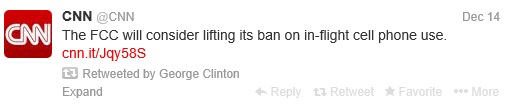
Is the culture ready for a George Clinton relapse?

If we’re not, maybe we should be since he’ll be turning 73 this July and… well… y’know…. mortality, etc.

Lollapalooza 1994 was a backhanded intro to the freaky Mr. C for parts of middle America and he’s kind of been doing his thing/”thang” ever since. This thing/”thang” largely consists of touring non-stop and getting namechecked. Although I do suspect he might be one of those artists that is discussed way more than he’s actually listened to. Others in this category may include Kraftwerk, (pick through this), Jandek and Danny Brown.

Aside: I once read somebody describing the Tragically Hip as “a mildly interesting bar band with an eccentric for a lead singer”. A bit weird that the exact same description could easily be applied to Parliament/Funkadelic.

.. or R.E.M..

Anyway, one tool that could help fuel this potential (time sensitive) relapse is Clinton’s surprisingly-robust Twitter feed and his ability to rebound a solid retweet. Much like “society” in a broader sense, social media is seen as a young person’s game. However, you’d never know it by taking a look at how older/elderly artists like Clinton are spreading knowledge and general weirdness by the channel. His retweet tendencies skew more towards the latter.

This post was alternatively going to be about solid Twitter feeds of Little Feat and/or Night Ranger, other acts than aren’t exactly “spring chickens”. Different sounds. Same difference.

Here are five recent @george_clinton retweets with 140 characters of analysis following each one.

**

gc1

@george_clinton starred as a character called Dance Crazy in this (apparently un)forgettable feature. It’s still real to @SHAQ!!!

**

gc2

@george_clinton would come out a spaceship on-stage so I guess that is his kinship with this tweet? Or he’s just fishing for a free phone.

**

gc3

@george_clinton has remarkably never played Coachella. And yet… #NiceGesture

**

gc5

#Value

**

gc4

#NoClueWhyHeCaresAboutThis

Ignored 23: No cover

RS500

The Rock & Roll Hall of Fame (& Museum) isn’t much.

I get the gist of what it’s trying to accomplish in creating a singular source (and tourist destination) dedicated to the immensity of popular music. In a (non-obvious) sense, I applaud their efforts in making artistic recognition more athletic recognition-ish.

I love music. I love sports. Let’s squish them together. In Cleveland.

However, on paper, populating a Hall of Fame of musicians makes no sense since artistic appreciation is 100 per cent subjective. Any effort to quantify “everything” is ultimately going to offend in the court of personal preference, not to mention realms such as gender, creed, sexual preference and age.

The physical Hall of Fame opened in 1995 and the concept seemed massively antiquated even at that time. Once Internet became the Internet, YouTube views and Twitter followers and iTunes sales became the new (and more legit) signifiers of “making it” rather than enshrinement and/or the chance to rub elbows with Jann Wenner and friends .

However, maybe that last paragraph doesn’t speak to an apples-to-apples comparison. “Greatest” (in a Rock & Roll Hall of Fame (& Museum) sense) shouldn’t be a measure of pure volume.

… and to clarify, that’s volume in the $$$/eyeballs sense and not in the “hey, Dinosaur Jr are f**kin’ loud” sense.

If we’re talking pure metrics, WWW-based signifiers would be more akin to:
– Albums sales
– Number of Billboard Top 10 singles
– Concert tickets sold

For math nerds or Nate Silver-types, these numbers are absolutes. But again, they are merely quantitative counting stats and not qualitative “greatness” measures.

The Rock & Roll Hall of Fame (& Museum) aspires to be the latter.

It never will be.

In short, does anybody really care who gets elected to the Rock & Roll Hall of Fame (& Museum)? With the possible exception of Rush (who’s fan base anecdotally has a disproportionate amount of math nerds and Nate Silver-types), there have been few fan bases who visibly gave a (damn) as to whether their favourite artist(s) was/were elected or not.

For modern superstars like Kanye West or the Arcade Fire, is anybody anywhere wondering how their latest album or tour will contribute to their respective Hall of Fame resumes? Of course, not. The Hall will continue to induct acts who are quantitatively great (ABBA, The Eagles) and acts who are qualitatively great (Laura Nyro, Randy Newman).

It’s fine. Nobody really cares and nobody puts any real demands on the Hall. Again, nerdy Rush fans are the exception to this rule. And perhaps the staff of PositivelyCleveland.com.

… strangely, this whole Rock & Rock Hall of Fame (& Museum) spew isn’t even the point of this post. It’s moreso a set-up to assess a pair of other “greatness” measures and determine if they’re still relevant in the present.

Exhibit #A

Most artists who appear on Saturday Night Live have hit some level of critical mass. There have been a few outliers over the years but in general, it’s a pretty static measure of popularity (greatness?).

Janelle Monáe, HAIM, Alabama Shakes and Kendrick Lamar are some of the artists who made the leap in 2013. On paper, appearing on a TV show that is almost four decades old seems a hugely antiquated measure of anything. However, the shareability of these performance via YouTube (and GIFs) gives an SNL appearance a cultural resonance that goes way beyond the original airtime.

Exhibit B

What about the cover of Rolling Stone? In general, nobody buys magazines anymore and Rolling Stone is almost a decade older than SNL. However, back in the day, a Rolling Stone cover was typically a guaranteed measure of both qualitative and quantitative greatness.

… In spite of this and this and this. Can’t win ’em all, I guess.

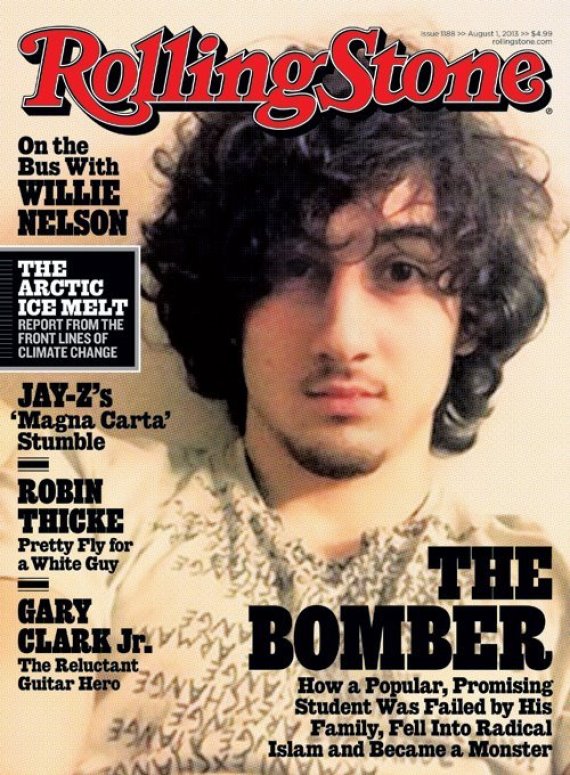
Circa now, the only time a magazine cover tends to get noticed is when controversy or nudity is involved. Boston (the city, not the band) freaked last year when Rolling Stone put civic bomber Jahar Tsarnaev on its cover, he looking very much like Syd Barrett in the process. Boston’s mayor got mad, a ton of people wrote about the controversy. Etc. Etc.

A hypocrisy ensued because on the one hand, we are conditioned to believe that nobody cares about magazines any more (statistics and this Twitter feed support this). And yet on the other, we are supposed to feign outrage when a player from within this (supposedly dead) medium does something irksome.

Parallel: the public outcry in Toronto over the sale of Honest Ed’s. Arguments rooted in neighbourhood preservation and community are completely valid. But the store itself? Kinda brutal and no doubt teeming the kind of sweatshop-supplied “goodies” that’d make Walmart seem righteous in comparison.

Anyway, the point is that magazines might be dead and/or dying but in the right context, a magazine cover story can still have a broad impact.

So what is the real value of a Rolling Stone cover in 2014?

I think the value is largely rooted in intent. Back in the day, a lot of Rolling Stone cover stories sought to lift the curtain on our heroes. Popular themes: substance abuse, the rigors of the road, grappling with fame, relationships, troubled childhoods, more drugs, more drinks, depression, drugs, rehab, a few more drinks, stronger drugs and death.

The writing had a lot of gravity (not in a bad way). The word “fuck” was typically left in (in a good way). Sometimes the articles were great and insightful. Other times, they were beyond pointless.

A 2003 Rolling Stone cover story on the Strokes is a good example of the latter. Tough assignment for journalist (and The Game purveyor) Neil Strauss, trying to get anything quotable from a band bred to look and sound bored. The full feature can be found here but more interesting is the play-by-play from Strauss’ notepad. Dude gave it the ol’ “college try” but this was an obvious “blood out of stone” scenario. Strauss should be commended for not hurling his pad towards Julian Casablancas’ face.

Again, the value of this brand of puff-y modern journalism is the intent, not the content.

In the present, lifting the curtain is a technique that publicists have reclaimed from journalists and bloggers. Wanna give your fan’s a peek at something? Put a snapshot on Instagram. Release a live recording on your website. Have your bassist tweet something wacky or offensive. Call TMZ.

The content is technical authentic but also completely fabricated. It’s so real, it’s fake.

On the flipside, subjecting oneself to a Rolling Stone cover feature is now (somehow) a post-modern means of letting go. By speaking to this under-read magazine, an artist is making this statement…

Hello. I am temporarily put my image in the hands of this writer. The resulting article will be largely irrelevant unless I say something provocative, stupid or racist. In short, the content doesn’t matter. What does matter is that this interview is an act of trust and I am comfortable with exposing myself in this manner. I hope this makes me look real. Because I am either real or want to be seen as real. Ideally.

This isn’t new. Trust has always been the subtext of any interview. What’s different is with so many more controlled options available to market oneself in the present day, there really is no need to pursue publicity in something as disgustingly antiquated as a (wretch… puke) magazine. Unless you’re consciously trying to make a statement about relinquishing control in a “I have nothing to hide” fashion.

The willingness is a statement. Everything else isn’t much.

Ignored 22: Revelations 2013

Ignored22

A selections of revelations revealed vis-à-vis CompletelyIgnored.com in 2013. Enjoy!

1. A person’s understanding (and by understanding, I don’t mean appreciation) of music is going to be predicated on whether they “lived through it”. (#ignored1).

2. The segment of the world population that TRULY “experienced” Kraftwerk is very small. (#ignored1)

3. If they were positioned differently, the Replacements could have had Bon Jovi’s career. (#ignored2)

4. The five-minute feud between Wale and the Toronto Raptors’ play-by-play team wasn’t anything. (#ignored3)

5. The iPod has morphed all “guilty pleasures” into simply “pleasures”.  (#ignored4)

6. The MuchDance CD series is the Nuggets of (underrated) Top 40 Europop. (#ignored4)

7. Coachella Festival speculation is the fantasy baseball of music fandom. (#ignored7)

8. The Columbia Record and Tape Club preyed upon the lazy and dim-witted. (#ignored8)

9. I listened to the Jesus and Mary Chain’s Psychocandy in a speeding motorboat. (#ignored8)

10. Being vague and/or absent is a good technique for bands to use to become more beloved. (#ignored9)

11. Adult moshing levels are a strong means of measuring the room energy of a live music performance. (#ignored10)

12. The Wikipedia definition of “headbanging” is amazing. (#ignored10)

13. SIANspheric were superior to 90 per cent of the original shoegaze bands. (#ignored12)

14. The Breeders would be remembered completely differently if they used different album art and weren’t signed to 4AD. (#ignored12)

15. The Cure’s “Friday I’m in Love” and R.E.M.’s “Shiny Happy People” were both good-to-great songs. (#ignored13)

16. Big Sean’s “Control” is not a diss track, (#ignored14)

17. People create fake LinkedIn profiles for their (assumedly) favourite musicians. (#ignored15)

18. Mating 1980s modern rock with 1990s Canadian beer advertising was a thing. (#ignored17)

19. Lou Reed spent his life conflicted between being Lou Reed and “Lou Reed”. (#ignored18)

20. “They’re awesome live!!” can be either a help or a hindrance in music marketing circles. (#ignored19)

21. Hipsters wrongly assume that R. Kelly is self-aware. (#ignored20)

22. Limblifter deserve a career achievement in the “random lip ring” category. (#ignored21)